


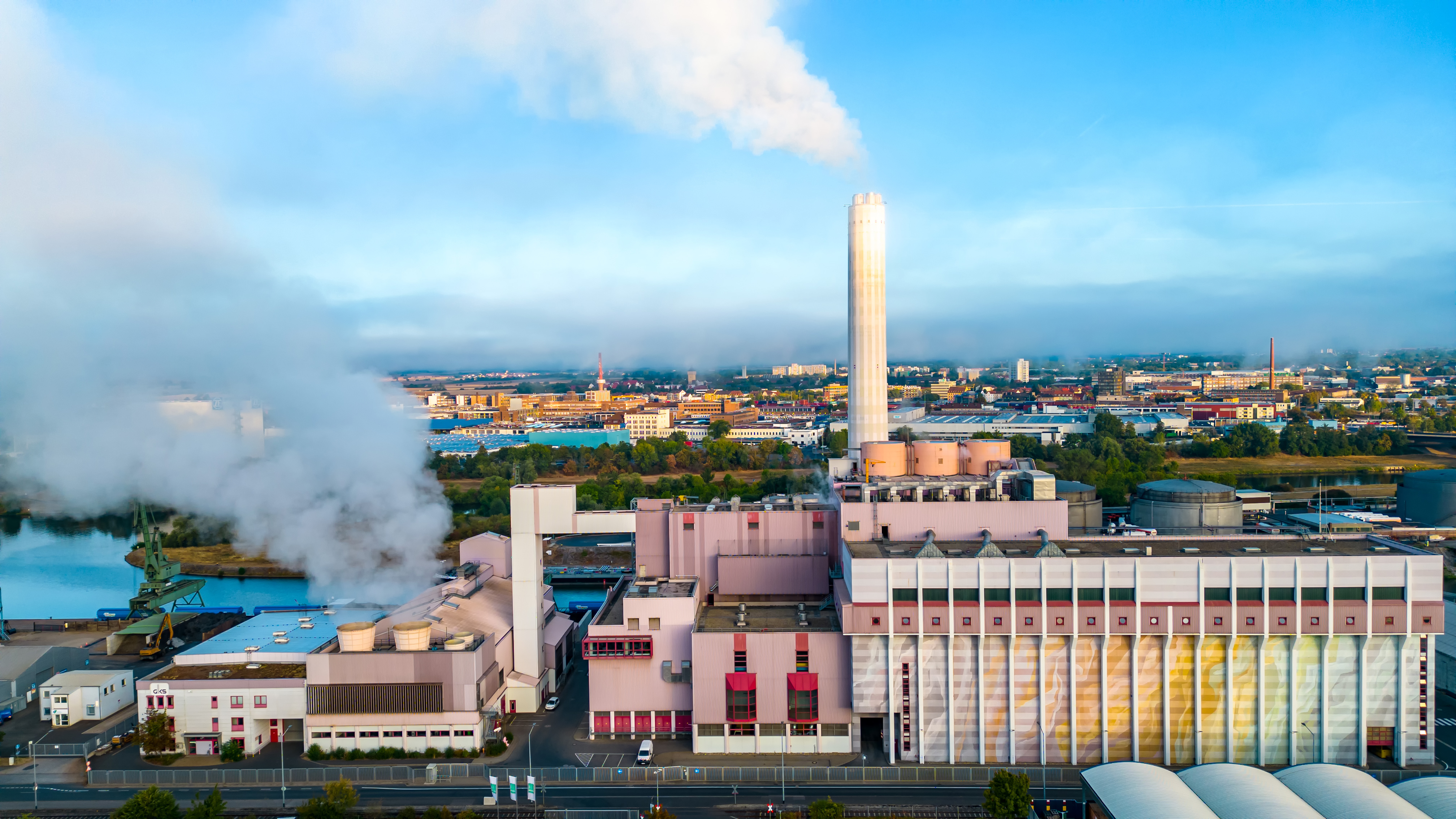
GKS has planned to invest € 84 million euros to prepare for large-scale sewage sludge incineration.
As recently as November 2024, everything seemed to be finalized, at least as far as the plans were concerned. The plans were in place. GKS wanted to invest 84 million euros in order to be able to burn dry sewage sludge on a large scale instead of coal in the future. It was slated to be one of only a few power plants in Bavaria to do so. That has now changed.
A shareholders meeting was recently held. On Tuesday, the GKS issued a press release. Its main point: The plans are deferred. "The planned conversion to incinerating the dry sewage sludge from the region will be postponed for the time being," it says.
The company intends to stick to its plan to phase out coal. However, this will be achieved through different means, and gradually starting in 2026. "The current CO2-intensive coal combustion will be replaced in a first step by converting to hydrogen-compatible gas boilers," GKS announced. The announcement mentions two to three gas boilers. Subsequently, at least one coal boiler will be converted to "biogenic fuels," specifically wood pellets.
The plans for dry sewage sludge will not be revisited until 2028. Then, "in a third step, the construction of a dry sewage sludge plant and a third turbine will be examined again." This will be based on the existing plans, heat demand, price trends, financing conditions, and available plant technology, according to the announcement.
The shareholders of GKS agree that the phase-out of coal combustion, which is legally mandated for 2038, should be completed as soon as possible. These shareholders include the industrial companies Schaeffler, SKF and ZF, the districts of Aschaffenburg, Schweinfurt, Haßberge, Main-Spessart, Miltenberg, Main-Tauber and Rhön-Grabfeld, as well as the cities of Aschaffenburg and Schweinfurt and the municipal utilities.
GKS cites several reasons for the change in plans, including excessive inflation in the capital goods sector and a market-adjusted number of available technology providers. The statement says that the now-agreed step-by-step approach will secure financing, enable flexible adaptation to changes in energy legislation and allow for a faster coal phase-out than originally planned.
Two-thirds of the district heating it supplies to industry and municipal utilities comes from waste incineration. The remainder is co-fired with coal, gas, and- since 2020 - dry sewage sludge. This sludge is dried externally, including at a facility in Würzburg.
A new special-purpose association for sewage sludge utilization has been established: 40 municipalities from Lower and Middle Franconia, as well as the Main-Tauber district, have joined forces to form the Main-Tauber-Aisch Sewage Sludge Utilization Association. A drying plant is to be built at the Würzburg waste incineration plant. According to current plans, the dried sewage sludge will then be incinerated in Schweinfurt, with phosphorus being recovered in the process.
The city of Schweinfurt is also among the 40 municipalities in the association. Having its own drying plant in Schweinfurt would have been too expensive, environmental officer Jan von Lackum recently explained to the city council's building committee. Therefore, sewage sludge from Schweinfurt is also being transported to Würzburg for drying.