


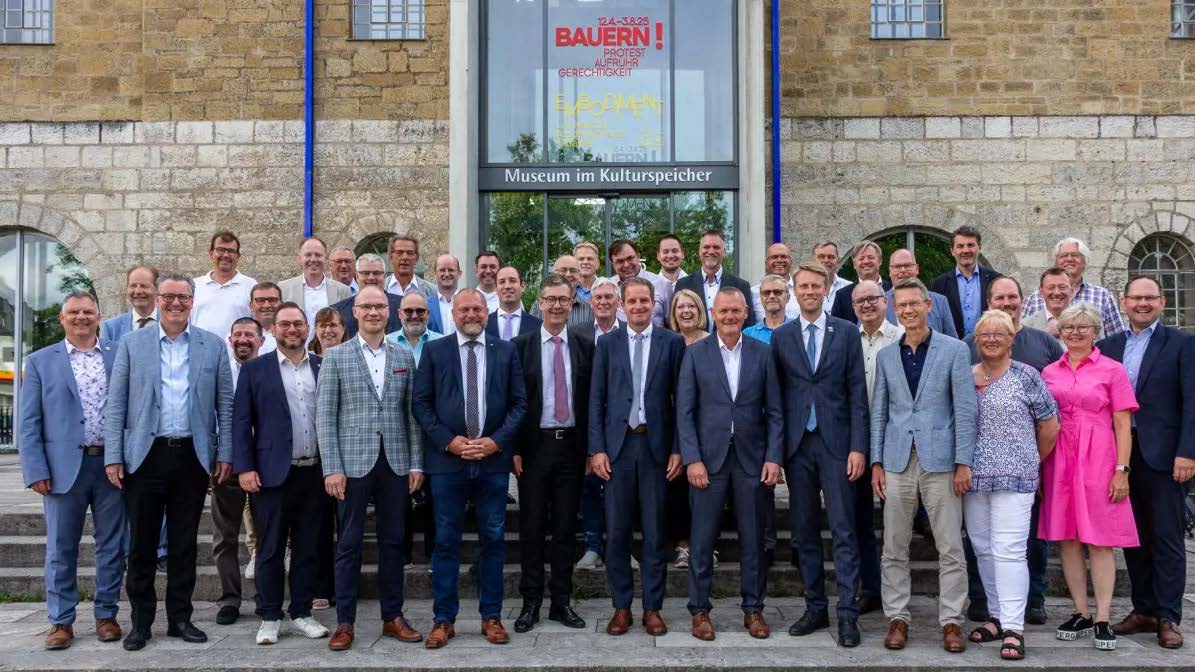
 The representatives of the member communities at the founding of the Zweckverband Klärschlammverwertung (Association for Sewage Sludge Recycling) at the end of June. Photo: Christian Weiß (City of Würzburg)
Regional cooperation sets standards in the circular economy: Dried sewage sludge will partially replace coal and achieve phosphorus recovery in the future
From the end of this decade, sewage sludge must be processed and the phosphorus contained in it recovered. This is what the legislator wants. 40 municipalities from Lower and Middle Franconia as well as the Main-Tauber district have now joined forces to form the Main-Tauber-Aisch sewage sludge recycling association in order to master this task together, reports a press release. It is not only about the conservation of natural phosphate deposits, but also about the extraction of renewable energy. The power plant in Schweinfurt (GKS) and the waste-to-energy plant in Würzburg (MHKW) play a central role in the plans.
In the past, the phosphate-containing residual sludge from the sewage treatment plants was brought directly to the fields as fertilizer. Because pollutants and drug residues also accumulate in the sewage sludge, it is now mainly incinerated in waste incineration plants - together with the other waste. The phosphorus contained is lost in the process. As early as 2017, the Bundestag therefore passed a law on the recovery of phosphorus from sewage sludge.
Mono-incineration is considered the most effective method of phosphorus recovery
The most effective method of phosphorus recovery is the mono-incineration of sewage sludge, in which organic pollutants are rendered harmless. More than 80 percent of the phosphorus contained can then be recovered from the ash. Another advantage is the high calorific value of dried sewage sludge, which is about as high as that of coal. However, the water contained in it must first be evaporated. Therefore, a drying plant is to be built at the MHKW in Würzburg, which uses the waste heat from the waste incinerators.
After that, the dried sludge is to be burned in a separate furnace line in the GKS and replace partially coal there. A total of 57,000 tons of dewatered sewage sludge from the approximately 40 participating municipalities from the districts of Würzburg, Kitzingen, Main-Spessart, Weißenburg-Gunzenhausen, Ansbach, Neustadt Aisch-Bad Windsheim, the city of Schweinfurt and from the Main-Tauber district will be processed in the future.
Würzburg's building consultant Benjamin Schneider, who also heads the business of the new special purpose association, recalls that work on the project began five years ago. A regional approach was pursued from the outset. "It is an important step that we also follow the basic idea of regionality in waste disposal," Würzburg's District Administrator Thomas Eberth is quoted as saying in the press release.
Source: Press release of the Main-Post media group | By Gerhard Meißner | 07/15/25